Field surveys conducted during the 2025-2026 water year show tree resilience (the ability to recover well from disturbance) but also highlight management practices that constrain recruitment success.
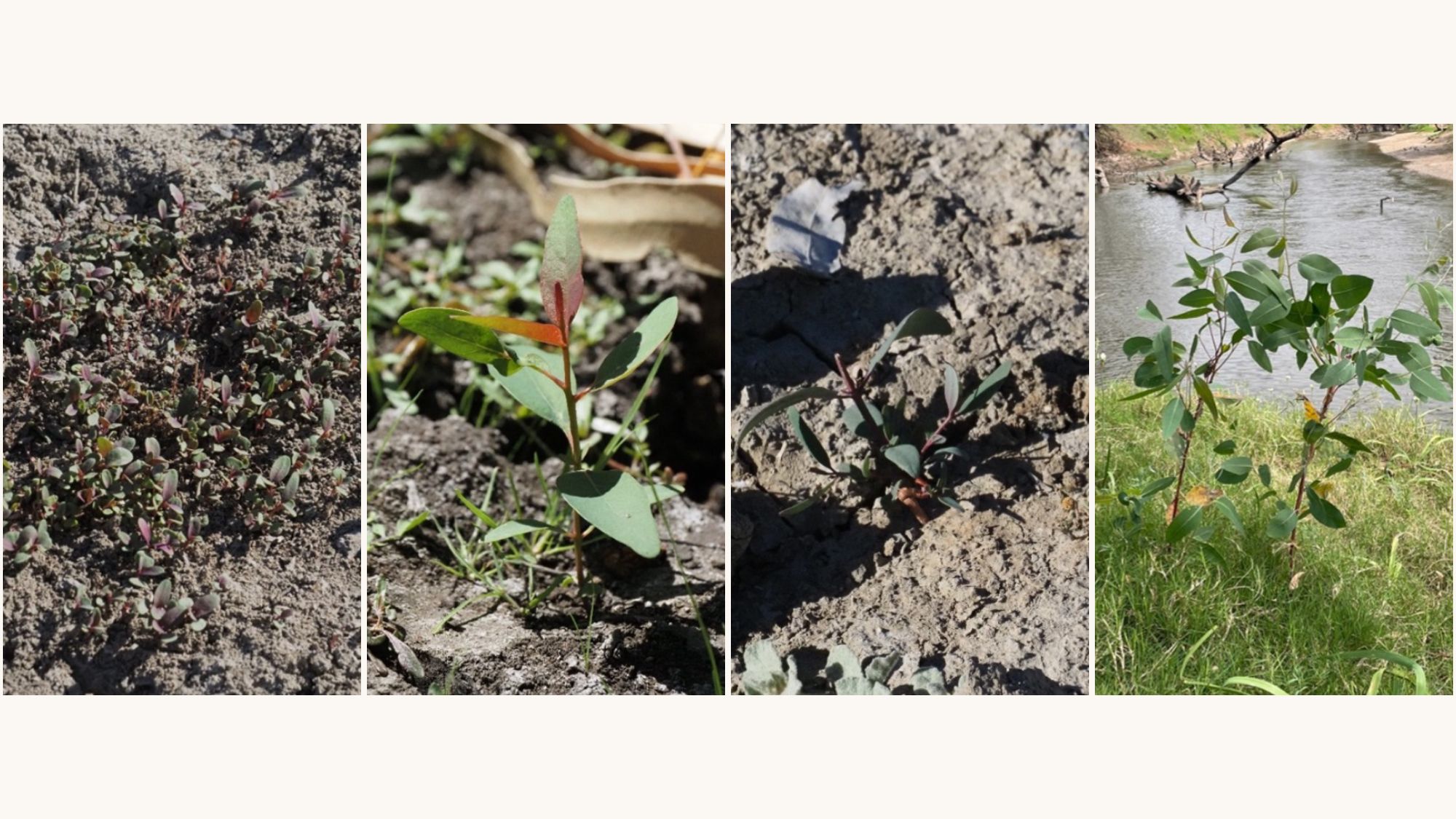
Flow-MER monitoring in the Lower Balonne during Autumn 2026 found large numbers of young eucalyptus and acacia seedlings (including river red gum (Eucalyptus camaldulensis), coolabah (Eucalyptus coolabah), and several acacia species growing along riverbanks. Some sites had hundreds of seedlings. Most were very small, less than 5 cm tall, which shows they had only just started growing.
These seedlings, or germinants, appeared after moderate flooding caused by rainfall in the upper catchment. They were mostly found in damp soils close to the water line, where water had slowly receded. These conditions are ideal for seeds to sprout and begin growing.
Another important finding was the presence of larger young plants (over one-metre-tall saplings) from species that usually grow in drier areas, including white wood (Atalaya hemiglauca) and emu bush (Eremophila bignoniiflora).
Their presence near river channels suggests that flooding over the river bank is less frequent than it used to be. Very few eucalyptus saplings (over one metre tall) were recorded, indicating that conditions are not suitable for their establishment.
Many of these small plants are unlikely to survive from the germinant and seedling stage to the sapling stage without enough rainfall or soil moisture.
They need these conditions so their roots can grow deep enough to reach groundwater. Seedlings are more likely to survive in ‘safe sites,’ where there is shade and protection. These areas often include fallen branches, leaf litter, and other low plants that create a better microclimate.
Tree seedling growth is also threatened by grazing and trampling by livestock and feral animals, fast-drying soils, sudden changes in water levels, unstable soils, and human impacts such as litter and vehicle use. All of these pressures were seen during recent surveys and can damage seedlings at critical stages of growth.
Frequent flooding can also harm seedlings. When floods happen too close together, especially during irrigation periods, they can drown young plants. Grazing pressure makes the problem worse, as animals eat new growth and trample soft soil. Limiting animal access to riverbanks is a simple way to improve plant survival.
If new trees do not survive, the population will become dominated by older trees. This increases the risk of major ecosystem change if those older trees die. Supporting a mix of young and old trees is important.
To achieve this, water management needs to allow time for seedlings to grow without sudden drying or additional flooding after germination.
%20(1).jpg)